One-Tank Offline Learning
This example identifies a one-step predictor from a simulated water-tank trace. It uses the same system definition and simulation as the incremental learning variant, while training each model from a fixed dataset.
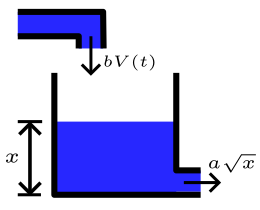
System and Data
The water level \(x\) follows
where \(A = 5\) is the tank area, \(a = 0.5\) is the outflow rate, \(b = 2\) is the inflow rate, and
examples/one_tank/system.py is the single source of this simulation. one_tank_system() represents the dynamics as a one-location HybridSystem with no transitions, and simulate_one_tank() returns a deterministic trace sampled from 0 to 25 seconds at 0.1-second intervals.
Both learning variants consume the resulting t and h columns. A three-sample SlidingWindow creates h_0, h_1, and h_2; the learners predict h_2 from the two preceding levels h_0 and h_1.
Offline Workflow
run_offline.py performs these steps:
- Simulate the shared one-tank
HybridSystem. - Apply a three-sample sliding window.
- Shuffle and split the fixed data into 80 percent training and 20 percent test observations with seed 42.
- Train a regression tree, a PyTorch multilayer perceptron, and a two-tree ensemble with
learn_offline. - Evaluate each model with mean absolute error, mean squared error, and maximum error.
The script prints training times and evaluation reports. Reported values can vary across platforms and ML backend versions.
Run
From the repository root:
To run both the offline and incremental variants:
See the Hybrid Systems guide for the simulation model and Learning Strategies for offline learning concepts.